
Divine Intervention: Religious Roots in Fashion
Words by Tricia Merone
Edited by Rachel Hambly and Bailey Tolentino
A socio-cultural system rooted in spiritual and divine belief, fashion has evolved into a modern religion of sorts. Far more similar in structure than they seem, religion and fashion are both governing forces in society, responsible for upholding strong histories, ethics, and lifestyles. Religion and fashion seem opposites, with religion rooted in tradition and fashion’s greatest moments marked by breaking it. However, they have found a way to intermix. While the rise of religious influence on clothing seems a modern development, religious symbolism was integrated into fashion early in the 17th century, as religious monarchs and royalty proudly incorporated crosses and other strong religious imagery into their garments. Religion and fashion have grown alongside each other for a few centuries, each branching into powerful industries with strong followings and a strong hold on modern-day society. As creativity has branched out in new directions, religion has become increasingly visible in fashion, twisting traditional religious roots into ideas that work alongside the fluid boundaries of fashion while simultaneously borrowing religious symbolism in ways that feel more stylistic than spiritual.
Devoutly Fashionable
As most distinctions have, the line between religion and contemporary fashion has blurred. Kanye West, for example, embodies an extreme religious stance while also serving as the figurehead of the popular clothing brand Yeezy. Similarly, influential social events have gone with religious themes, such as the Met Gala’s lauded "Heavenly Bodies” theme in 2018, which aimed to explore the intersection between fashion and Catholic art. As is the case with most Met Galas, the outfits showcased were celestial, with catholic inspiration reaching as far as a Cartier-encrusted Pope-inspired hat worn by Rihanna and a Joan-of-Arc-inspired Versace look sported by Zendaya.

Rihanna, ‘Heavenly Bodies’ Met Gala, 2018, Harper's Bazaar
While that instance is an appropriate use of ‘Catholic imagination,’ there have been inappropriate uses of religion in fashion trends of late. Fashion has converted the traditionally meaningful system of religion into a shallow, one-dimensional source of aesthetics and means of promoting a social agenda. While some celebrities and figureheads have used fashion to display their personal beliefs to the public, religion and religious symbolism have, in general, been manipulated for visual purposes, with no underlying spiritual or moral convictions behind the act. Fashion has always been a political tool, so while most clothing adorned with religious symbolism may be for aesthetic reasons, the spiritual message may be unintentionally proclaimed by the prophet that is fashion.
Divine Designer – The Discovery of Religion in the 80s
About 200,000 years late, designer brands discovered religion as inspiration in the late 80s, with brands such as Jean Paul Gaultier, Alexander McQueen, and Dolce & Gabbana designing collections full of religious symbolism, imagery, and even religious garments. In a devilish devotion to religious concepts, Alexander McQueen’s A/W 1996 Dante collection wove together the seduction of religious imagery with daring, provocative fashion. Staged in Christ Church, the show was a dark seduction drawing on Dante’s Divine Comedy, one of the greatest works of literature from the 1300s, which depicts a symbolic journey through the Christian afterlife and the underworld. As all religions have provoked in the past, intense controversy plagued designer Alexander McQueen following this show, catapulting him to fame, which was further instigated as he publicly commented on the show – “I think religion has caused every war in the world, which is why I showed in a church.” The cuts, construction, and layered silhouettes of some pieces featured in the show discreetly reflected early Netherlandish religious paintings, while other pieces, including a silver crown of thorns and crucifix-covered masks, proclaimed their religious inspirations more overtly.
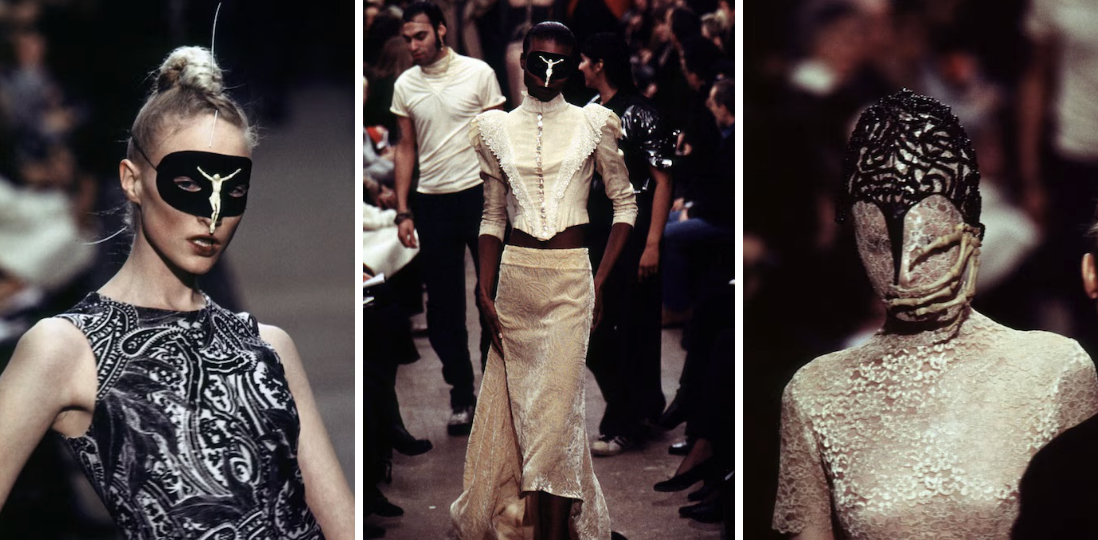
Alexander McQueen A/W 1996 Dante Collection
By drawing on religious inspiration, McQueen hoped the show would provoke repulsive feelings of shock and awe, following a show governed by complex emotion. The depiction of Dante’s Inferno is far from a comforting image, yet McQueen artistically molded the intense influence of this religious literature into a provocative and striking collection, leaving viewers with a morbidly moving mix of feeling, which, after all, is the essence of fashion and art in their true forms. More than just clothing, this amalgamation of religion and fashion resulted in an entirely new idea, more art than fashion, more conviction than religion.
Dolce & Gabbana reflected on this religious inspiration in 2013, with their Fall/Winter collection that drew inspiration from the Monreale Cathedral in Sicily, fusing 12th-century religious architecture with fashion. While a means of intermixing media of art, religious-inspired fashion also allows for a connection to tradition, a foundational concept that draws the whole of society together, religious or not.

Dolce & Gabbana Fall/Winter 2013, Vogue ‘Dolce & Gabbana Fall 2013 Ready-to-Wear’
Melding religion and fashion is a spiritual ordeal in itself – Alexander McQueen and Dolce & Gabbana exemplify how this fusion can honor the intricacies and artistic depth of both worlds, an approach increasingly rare in modern fashion. Today, many popular brands incorporate religious symbols rashly, overlooking the power and emotional weight these symbols carry in their original contexts. Chrome Hearts, for instance, adorns its clothing with crosses and other pseudo-religious symbols purely to evoke an ‘edgy, gothic, rock n’ roll’ aesthetic, rather than to reference any genuine spiritual inspiration. Similarly, Praying, a popular street-wear label known for its graphic-heavy designs, uses phrases like ‘God’s Favorite’ or ‘The Holy Trinity’ on risqué bikinis and ironic t-shirts, detached from any actual religious commitment.
Though born from different foundations, fashion and religion have always crossed paths. Sacred symbols inspire designers, and fashion, in turn, reshapes religious garments of worship. And even when religion is borrowed only on the surface, its history and emotional power elevate the art and message of clothing, binding together two worlds where devotion and design converge.