
On Valentino and the Permanence of Beauty: Elegance, Discipline, and a Life in Fashion
Words by Zeynep Baser
Edited by Rachel Hambly and Bailey Tolentino

Image Courtesy of Vogue Italia, Valentino Garavani Tribute Cover
There are designers who respond to the moment, and there are designers who outlast it. Valentino Garavani belonged entirely to the latter. His work was never driven by urgency or reaction; but by continuity, manners, and an unshakeable belief that a disciplined approach to beauty could endure beyond fashion’s cycles.
Valentino designed from within a world rather than at a distance. He understood elegance not as an image, but as a way of moving through life. His clothes reflected a rare intimacy with the women who wore them: women whose lives required garments that felt effortless yet exacting, refined without rigidity. He did not observe them from afar. He lived alongside them, shared their rhythms, and understood their needs instinctively. This proximity gave his work its authority; He had an understanding of women and of dressing that few other designers have matched.
In an industry that increasingly relies on concept and provocation, Garavani’s work stood apart through its refusal to intellectualise beauty. His gowns did not require explanation or lean on irony and theory. They trusted proportion, colour, and craftsmanship to speak for themselves. This trust was not naïve; it was earned and perfected through decades of consistency and conviction.
Craft sat at the centre of this philosophy. Valentino Garavani treated couture as a form of knowledge passed down through discipline rather than disruption. His ateliers were spaces of continuity, where skill was preserved and elevated rather than reinvented for effect. Each garment carried the weight of training and tradition, and nothing was casual or accidental. Luxury, for Valentino Garavani, was defined by precision.
Colour became one of the clearest expressions of this restraint. “Valentino Red” achieved its status not because it demanded attention, but because it commanded presence. Bold without aggression and emotional without excess, it embodied his understanding of reticence as power. The history of Valentino Red is often traced back to a moment of revelation in Barcelona, when Garavani was struck by the intensity and richness of the red worn by women at the opera house. From that point on, it became not simply a signature, but an ethos.
Unlike trend-led colour moments, Valentino Red has remained constant across decades, appearing in couture collections as an assertion of confidence rather than novelty. It was never seasonal. It was never ironic. It has always functioned as an identity built through repetition, discipline, and conviction: one of the clearest demonstrations that permanence in fashion — when executed properly — is achieved through consistency rather than spectacle.
Under Mr. Garavani’s vision, Valentino achieved something few brands truly manage: colour as identity rather than aesthetic choice. Much like Tiffany Blue, which operates as an instantly recognisable visual shorthand for heritage and romance, Valentino Red became inseparable from the house itself. Other attempts at chromatic authorship elsewhere in fashion, such as the lacquered red sole of Christian Louboutin, demonstrate how difficult it is to embed colour so deeply into a house’s mythology. The Louboutin Red is striking, but it functions merely as an almost kitschy accent to the shoe rather than a representation of the brand’s core values. Valentino Red, on the other hand, is a visual code for Garavani’s designs and the notion of feminine beauty it represents.
What this reveals is that permanence in fashion, when executed with discipline, is not achieved through spectacle but through consistency. In a system built on reinvention, Valentino Garavani understood that repetition, when deliberate, does not dilute identity; it fortifies it.
That symbolism was echoed poignantly in Vogue Italia’s memorial cover this January, which appeared entirely in Valentino Red in honour of Mr. Garavani following his passing. Stripped of imagery and reduced to colour alone, the cover functioned not only as a tribute but also as an act of reverence. Red stood for both absence and presence, a visual language capable of carrying memory without explanation. It was a reminder that Valentino Red has long transcended branding. It has become a means of emotion, legacy, and recognition: a colour powerful enough to speak for itself.
To reflect on Valentino’s passing is to reflect on an era when fashion was inseparable from living well. A time shaped by travel, ceremony, and social grace. His work carried the confidence of a world that did not need to justify its elegance. Today, as fashion accelerates and explanation becomes obligatory, Valentino’s quiet assurance feels increasingly rare.
Reflections from those who knew him illuminate this sensibility with clarity. Writing for Vogue, Anna Wintour described delight as the word she most closely associates with Valentino, recalling his impeccable manners, generosity, and extraordinary attentiveness to the women he dressed. To lose him, she suggested, was to lose one of the last great couturiers shaped by fashion’s most elegant, jet-set era, a designer who did not simply dress women, but celebrated the very idea of them. The House of Valentino will continue, adapting to new narratives and new hands.
With the appointment of Alessandro Michele, formerly creative director of Gucci, Valentino recently entered a new chapter. Where Garavani favoured architectural restraint, Michele introduced romantic density. The newest collection unfolds in layers: ecclesiastical lace, elongated silhouettes, polka-dot chiffon, bows fastened at the throat in that unmistakable Valentino Red Michele has openly admired Garavani’s engineering precision, and that reverence is visible in the construction.
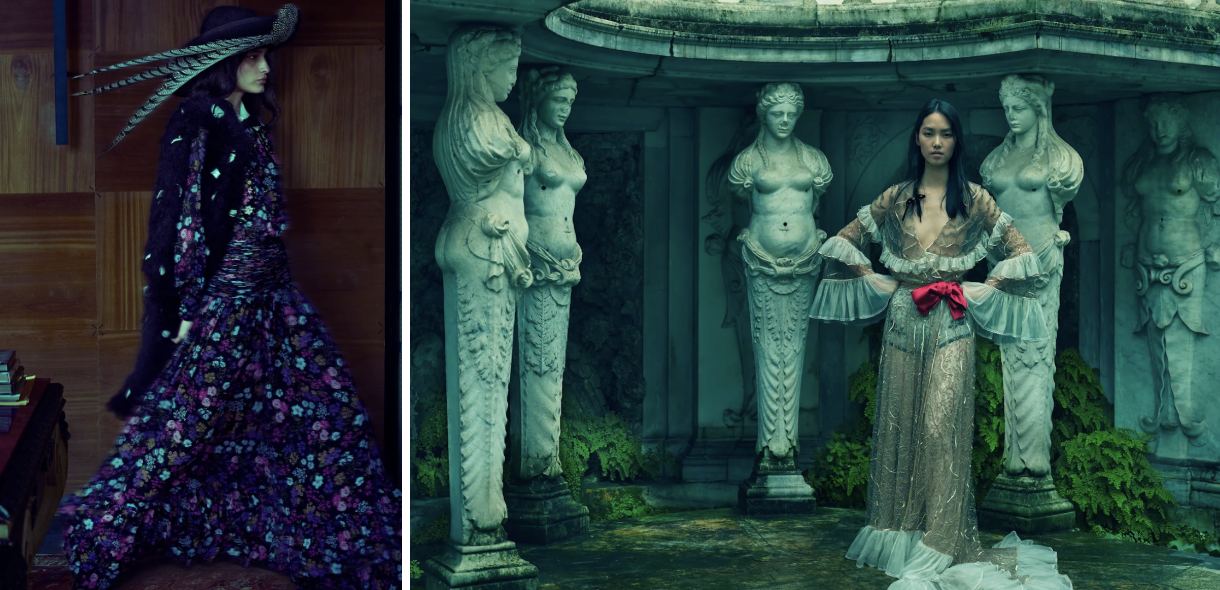
Photography by Annie Leibovitz, Courtesy of British Vogue.
In his interview with British Vogue, Michele speaks of Garavani’s technical mastery with a tone of reverence, describing the pleated constructions as “like an origami”: engineering disguised as delicacy. In this framing, the archive is not a relic but a collaborator. This is perhaps the most compelling aspect of Michele’s approach: he does not position himself against Valentino Garavani, but beside him. When asked whether a silk-chiffon polka-dot gown was archival or new, Michele answered, “This is him, with me… We are both in the same dress.” It is a statement that reveals continuity and respect beneath ornamentation. The gown, with its ruched bodice and cascade of pleats, could have stepped from an early-1980s royal wardrobe, and Michele delights precisely in that suggestion of the démodé. What looks old, he insists, will soon feel urgent again.
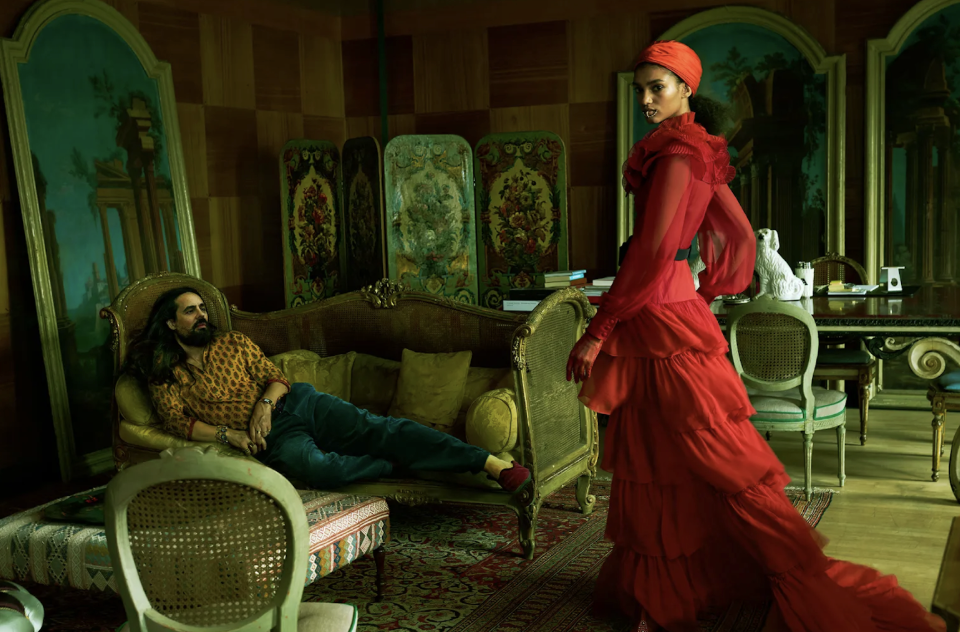
Photography by Annie Leibovitz, Courtesy of British Vogue.
Alessandro Michele, next to an unmistakable Valentino Red gown.
Recently, in his Spring 2026 Couture, Michele unveiled a series of circular “kaiserpanorama” viewing rooms that forced spectators to slow down and look. The inspiration for the collection drew on multiple eras, from 1910s silhouettes to 1980s drama. There were velvet trapunto suits, creamy satin slips, embroidered capes, flame-kissed sequins, and elaborate feather headdresses, with moments of Valentino Red anchoring look after look. The result was not just a pastiche but a tapestry of moods that felt both intimate and theatrical.
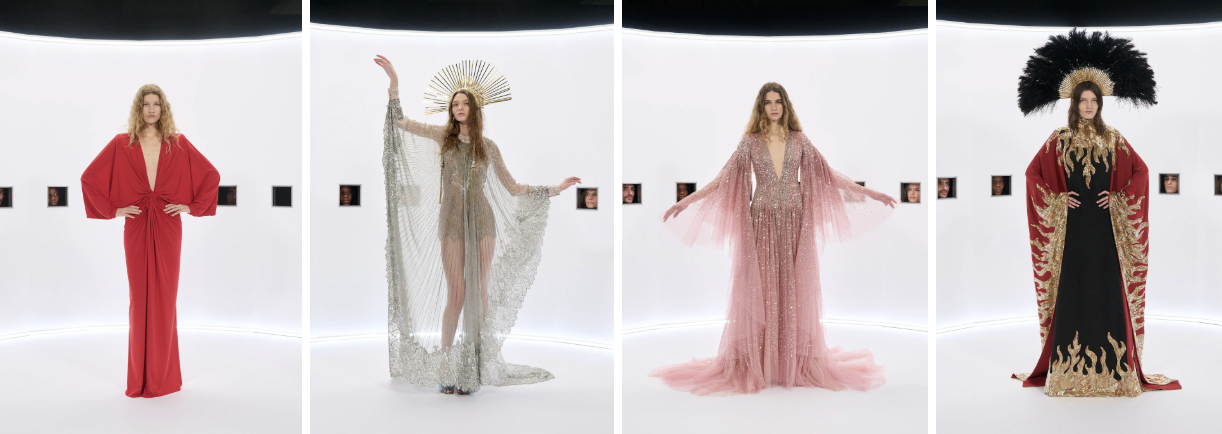
Photography Courtesy of Vogue Runway
Valentino Garavani built a legacy through consistency, manners, and an unwavering commitment to elegance as a form of respect: for the woman, for the craft, and for fashion as a cultural language. His work reminds us that delight, when practised alongside discipline, is not fleeting. It is everlasting. And in a world that increasingly confuses novelty with progress, that belief may be his most enduring gift.