
Clothing and Memory: the Ultimate Value of Hand-Me-Downs
Words by Frances Davis
Edited by Rachel Hambly and Bailey Tolentino
Fashion, like everything else, is rooted in history, and furthermore cultural memory. For centuries, designers and creatives across the board have been inspired by that which pre-existed them. This inspiration is often explored through revisiting historical styles or design movements, drawing relevance and beauty by evoking the shared sense of sentimentality for the past.
This connection between fashion and cultural memory has been repeatedly explored in recent years. Mathieu Blazy’s Arts Metiers show for Chanel is a prime example of how these abstract ideas of passing time and memory leave lasting impressions on material culture. Both implicit and explicit references evoked Chanel’s origins. They shared childhood experiences with TV and cereal box characters, producing a show that effortlessly merged fun, sentimental pieces with the high-fashion brand name.
Look 35 recalls Clark Kent concealing his Superman identity under seemingly regular office attire. Look 48, while less obvious, imitates Winnie the Pooh’s sidekick, Tigger, by incorporating the well-loved character’s orange-and-black striped motif. Beyond these two looks, the whole collection seamlessly weaves a novel sense of fun and whimsy into high fashion, with many of the looks easily traceable to childhood and vintage styles. Blazy draws on the shared cultural experience of nostalgia to create a poignant, evocative show.
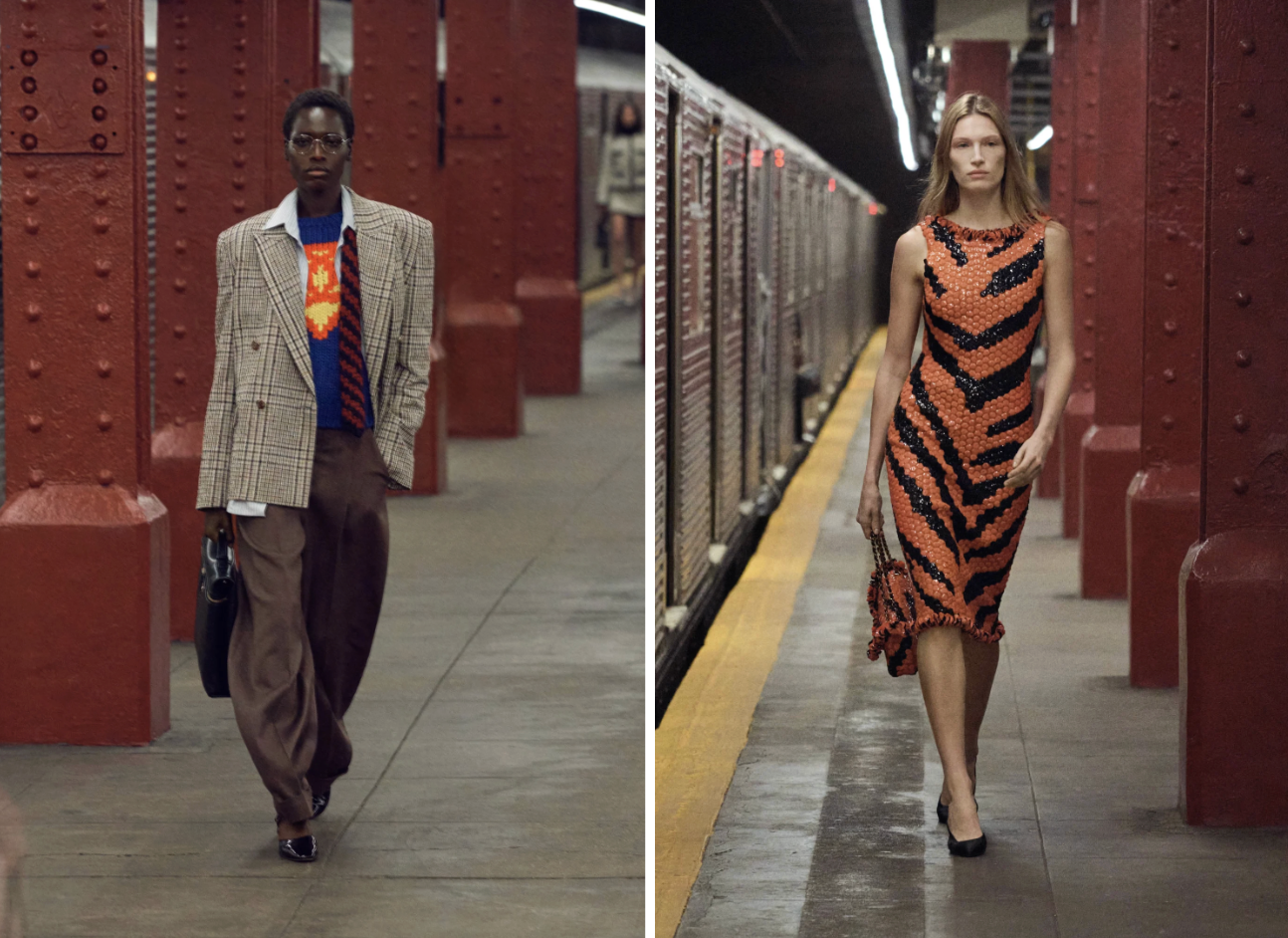
Chanel Métiers d’Art 2026, Looks 35 & 48. Source: Chanel
Blazy’s show inspired me to think about how my own childhood and experiences manifest in my day-to-day appearance, as well as how memory prevails through how I choose to adorn myself. Hand-me-downs have been prevalent in my closet my whole life. Whether it be bulky sweaters I stole from my father’s closet long ago or my mother’s “lucky” pair of striped socks, I am surrounded by physical pieces of my family; articles that I treasure all the more for their sentimentality. To be able to wear these items that were once treasured by family members or friends, I keep a piece of them with me wherever I may be. The ability clothing has to hold memory is a fascinating subject to me because of this relationship I have long had with hand-me-downs, and it inspired me to ask some friends how they regard clothing passed down through generations and the memories associated with them.
How much of your closet has been handed down to you by a family member, friend, or other? Do you wear these articles more or less than those you might have bought at the store?
TB: Approximately 60–70% of my closet is made up of hand-me-downs. I think I wear those pieces more often, mainly because they occupy the majority of the space, and […] tend to end up being my favourites anyway.
JR: I would say about 25% of my closet is hand-me-downs. This number is relatively low not out of choice, but mainly because I think there is a smaller culture surrounding men when it comes to sharing/handing clothes down. That said, when I was younger, my closet was almost entirely hand me downs from cousins or friends who were bigger than me and who had grown out of gear. Some of my favorite pieces of all time have been HMDs.
How would you define your understanding of nostalgia as it plays out through fashion? Do you consider yourself a particularly sentimental person and are you more inclined to wear something if it is reminiscent of your youth?
TB: Nostalgia does play a role in how I relate to fashion, but it’s not really about my own childhood. It's more of a subconscious awareness that the clothes I wear, especially second-hand pieces or hand-me-downs, had a life before me. I'm not particularly sentimental, but I'm drawn to things that feel lived-in.
JR: I’m not sure nostalgia comes out much through my fashion choices today, meaning I don’t go out of my way to pick up pieces for the sake of nostalgia. That said, I do consider myself a sentimental person, and if I am gifted or come across an article of clothing that is similar to one that I loved during my childhood, I would definitely be keen to pick it up.
Clothing is often quite dear to us, and our favorite pieces usually hold a certain level of significance. Do you find yourself inclined to lend your items out? If so, how do you regard that experience of giving up something dear to you, even if it is soon to be returned?
TB: I actually really like sharing my clothes–there’s something about it that makes me feel connected to the people who wear them. Maybe it comes from being in boarding school, where my dorm essentially had a communal closet and everyone was always borrowing from everyone else. Thus, lending things out doesn’t feel like giving something up, more an extension of me to other people.
JR: Once again, I feel as though men may not do this sort of exchange or lending as commonly as women do. The closest-swap culture really isn’t huge for men. We have our own clothing and tend to stick to it. The exception to this would be if I am giving away sentimental pieces to neighbors or friends who have children who are younger. As a kid, I received many sports jerseys, ski gear, and other snazzy pieces from friends and family members who were older than me, and often I enjoy doing the same for the next generation, as I remember how happy it made me as a kid to receive boxes of old jerseys and such.
On the flip side, do you ever feel a weight or responsibility that accompanies a passed-down piece? How do you think memory affects value and what do you think makes something sentimental?
TB: Honestly, I don't really feel a weight or responsibility with passed-down pieces. For me, it isn’t that deep; it’s just something sweet. I think memory can add value, but only in a gentle, personal way, not in a heavy or symbolic sense. Something becomes sentimental when it carries a nice association or feeling, not because it’s meant to represent anything bigger.
JR: I'm not sure I’ve ever felt a weight in a passed-down piece, but I totally think that memory affects personal value. For example, my favorite hand-me-down item of all time was an old Irish National Football kit from the early 2000s. It was given to me by a neighbor of mine who was a few years older than me. For one, I thought it was the coolest thing ever that I was able to wear his jersey, and it quickly became a favorite of mine. When I finally outgrew it, I decided to keep it. Not entirely sure why, I suppose my thinking was that one day I could give it to my kid, but that’s pretty far down the line. The jersey isn’t anything special. It is a worn out, stained, green kit with a big clover on the chest, but I love it. It is those kinds of memories that affect sentimental value for me.
What is your favorite hand-me-down item and what is the story- if there is one- behind it?
TB: Probably my mum’s long-sleeve top with Japanese calligraphy, or any of my dad’s jumpers. Most of these pieces just find their way into my closet without much intention, but they always end up being the coziest things I own. I also really love that six out of my seven pairs of sambas once belonged to an old friend from boarding school!
Their answers, as well as the recent Chanel Metiers d’Art show, insinuate that nostalgia often adds value to clothing; the story a piece tells is fundamental to its desirability. Clothing can carry legacy; the lives of those whom it has previously adorned endure through the article’s second life. Day-to-day fashion choices come from a deeply personal place, drawing on life experiences and a wide array of influences. Clothing often reflects one’s persona—they carry our stories and personalities with us even after being handed down. A shirt that has been shared is never just a shirt; it has gained memory, legacy, and sentimentality, transforming it into an extension of one’s inner self.