
Does Everything Have to be Niche?
Words by Clementine Wilson
Edited by Rachel Hambly and Bailey Tolentino
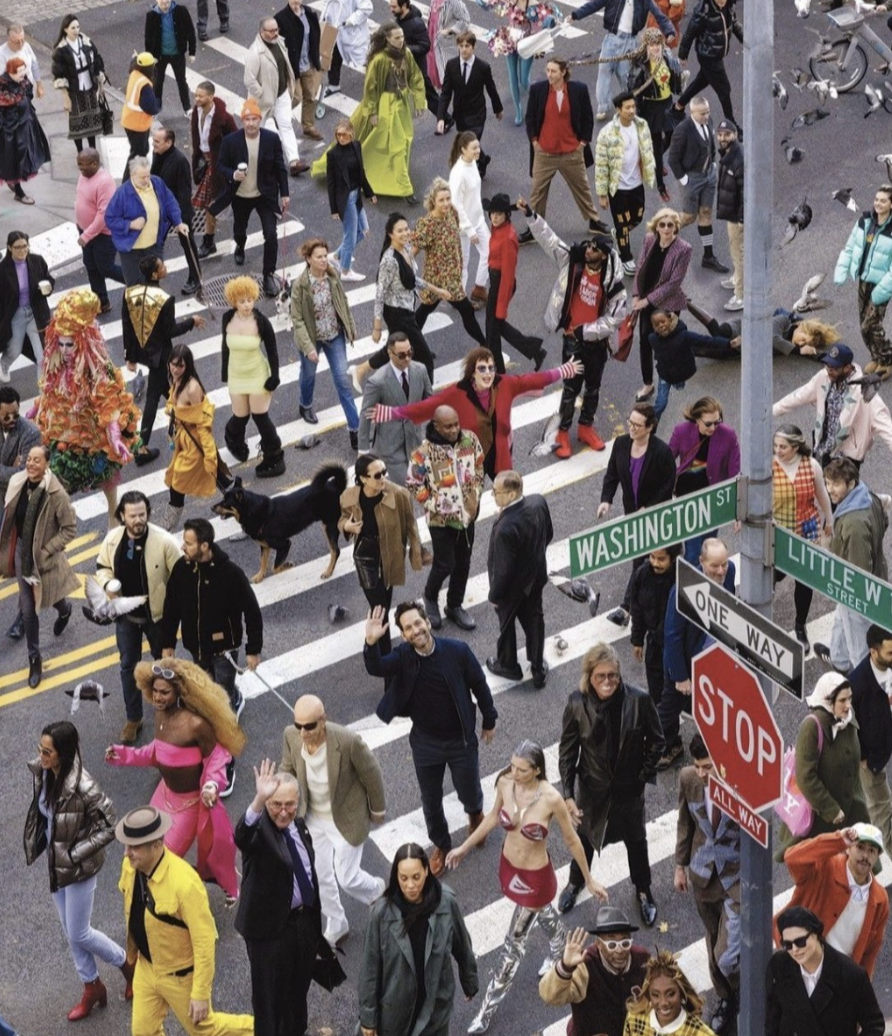
@Pellecass on Instagram
The internet is amazing. I see people in places I can’t pronounce, living lives entirely different to mine and those I’m close to. With a few flicks of my thumb, I can go from watching a man in Taiwan make soap from scratch to watching two Slovenian kids breakdance to Daft Punk.
The internet can also be overwhelming. It has changed how our world looks and operates, compared to thirty, even twenty years ago, when the media was consumed very differently. There were plenty of outlets – MTV, magazines, the radio – that enabled you to access a wide variety of entertainment, but they weren’t personalised like social media algorithms are today. Cable meant that all the same shows were streamed to folks who’d plan their day around the same time they’d be aired. People were exposed to the same things whether they liked it or not, and even if they didn’t love every show or artist they saw, a sense of shared culture (or monoculture) was created. There were no avalanches of bite-sized content precisely tailored to each individual.
Nowadays, from Honolulu to Timbuktu, users are fed a steady stream of content that, compared to twenty years ago, seems like it's on steroids. It’s become more distracting, time-consuming, and accessible than ever. Whenever I look at my phone, my allotted five-minute break stretches into forty; and by the time I turn it off, I’ve seen people perform insane feats on snowboards, a girl in Midwest America show me how she changes her colostomy bag, and every allegory behind every Studio Ghibli film ever made. I also somehow know how to pronounce several words in Japanese that I don’t know the meanings of. I’m left exhausted, overstimulated, and very brain-dead.
And that’s only my own feed, which usually mainly consists of videos of surfers and films that I like. I look over to my dad’s phone, where he’s watching much more politicized content, like videos of world leaders speaking at conferences about the dire situations in Ukraine and Gaza. He might engage with the occasional, less serious, post from the account @trainsrunningoverthings. I turn back to my own phone and sigh. I think if I tried to imagine what every individual’s social media algorithm looks like, my head would explode. It feels like people now belong to so many micro-communities online, each with its own unique context. My friends and I now all make jokes and references to trends, and if others were there to overhear but haven’t kept up with them, they would probably think we sound mad, or perhaps we’re all simply too online. But maybe that isn’t really our fault.
This brings me to my actual point: Does everything have to be niche? I’m not sure if this is the same for everyone else, but the kind of stuff I’m seeing feels like a competition for who can have the most unique looks, most esoteric experiences: raves in abandoned temples in Taiwan, girls showing off their vintage Miu Miu shoes while waiting for the bus in Kazakhstan. Does everyone have to build a personal brand, a constant performance for the internet? These online personas just feel contrived but pose as esoteric, for they’re inspired by content tailored only to a ridiculously niche subset of interests.
It almost feels like I’m living in a show where everyone around me is a member of an unengaged audience, and each of us is locked in a constant state of performing for each other. The chances of being out in public where someone with a camera could catch me at my worst have gotten so high that I never want to leave the house without looking my best. Although I don’t know who I’m performing for, for some reason, I’ve convinced myself that there’s always an audience. As Margaret Atwood put it so plainly: “You are a woman with a man inside watching a woman. You are your own voyeur.” It seems like not only women live with little voyeurs inside them, but everybody does; the rise of the trending “performative man” exemplifies this. Everybody on social media is watching one another, aware we’re being watched, aware that our observations are being watched, too. And the lines between what’s put on social media and what’s reality are being blurred. Somehow, two things are trending: the desire to be different, as well as a desire to be indifferent and apathetic; in other words, “nonchalant”. Content is flooded with scrutiny and made fun of, producing an intense fear of being judged and laughed at for being seen doing something “different.” The grand irony here is that no one really knows what the rules are for acceptance. There are a million ways to be “different” and “uncool” but no one way to be the “same” without being “unoriginal” or “boring,” either. It is a losing game on all ends.
This way of thinking troubles me. I find it difficult to accept that, in this political climate, this bubbling fear isn’t one that we’ve not culturally experienced before. The wounds run deep between creatives, or those who are “different”, and authoritarianism. Authoritarians, who rely on order and stability, are particularly frustrated by creative thinking, which inherently challenges established rules, hierarchies, and control. This is, nowadays, sounding a little too relevant to the United States of America, which finds itself in the midst of political turmoil and the potential for further instability. Its current president, Donald Trump, has a contentious relationship with multiple high-profile figures in the arts industry (Taylor Swift, Lady Gaga, Bruce Springsteen), having publicly insulted them, often in retaliation for their own public demonstration of support for his political opponents. Almost everybody who has contributed to culture artistically was a nonconformist, a visionary, a rule-breaker. Their choice to go against the mainstream, to put their toe out of line, and to be unafraid to express their differences made them who they are. And yet we find ourselves stuck in an unfortunate wave of thinking, one where whatever we create gets tossed in the bin or saved as a draft, for if it cannot be appreciated or celebrated, it would be ridiculed.
This is only the first example of how being “different”, of how American society under this authoritarian-adjacent regime is becoming increasingly anti-intellectual, disrespectful, and perverse. But one strong source of defiance is our growing obsession with all things niche and esoteric, things that stand out, that are different to us, to how we live, and what we value. So yes, everything does have to be niche. The nicher, the better; the more different, the better. The more power it has to encourage curiosity, further appreciation, and foster diversity, the better. The wackier it looks, the more bizarre it appears, the more foreign it seems, doesn’t matter. Because our generation’s focus is turning towards more obscure subcultures and passions, there will almost always be a group of people who share them. Every time I get lost down an online rabbit hole and am not quite sure how I ended up surrounded by these niche subsets, I’m glad they’re there; they’re breaking up monolithic popular culture, and they resonate with enough people to build community.