
Matières Fécales’ The One Percent (FW26)
Words by Lena Sophie Eckgold
Edited by Rachel Hambly and Bailey Tolentino
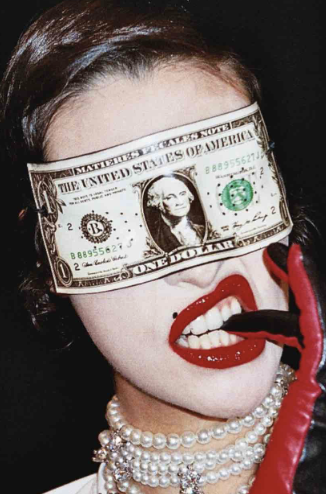
On 7 March, the duo Hannah Rose Dalton and Steven Raj of Matières Fécales presented their Fall/Winter 2026 collection, The One Percent, at Paris Fashion Week. Following their successful debut collection, The Other (FW25), which explored socially marginalised queer identities – already worn by FKA twigs and Lady Gaga – this year’s collection turns its attention to those who perpetuate marginalisation: classism, capitalism, the white elite, and their power structures.
The title The One Percent itself refers to the global distribution of wealth. According to analyses by Oxfam, the richest 1% of the world’s population owns almost half of all wealth. Although this elite remains largely invisible to the general public, recent scandals, particularly those linked to the Epstein Files, have at least partially exposed its dark underbelly. In Matières Fécales, this elite is actively staged, both imitated and grotesquely exaggerated. At its core, however, the collection is concerned with power as a universal relation.
For the One Percent, they chose a venue that could scarcely have been more symbolic: the Palais Brongniart, a former Paris stock exchange commissioned by Napoleon, which still functions as a stock exchange and a hub for capital today. The video recording of the show begins with a solar eclipse, a symbol of disruption of order and transformation, or perhaps apocalyptic foreboding. Minimalist piano tones gradually develop into a menacing, distorted electronic soundscape. The room is dark, the walls and floor black; only selective spotlights define the catwalk, at the centre of which lies a circular space. The show is divided into three tableaux: Power of Archetypes, Power of Community, and Power of the Future.
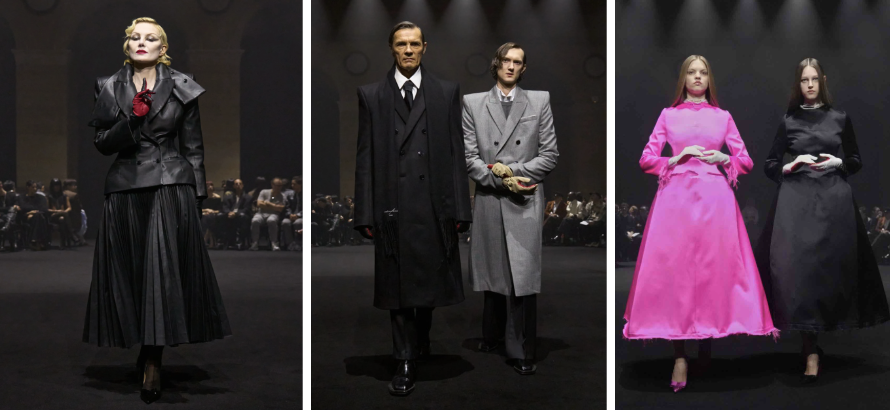
In the first part, the models move in an exaggeratedly theatrical manner, sometimes staggering and with almost drunken steps. Their gazes are unsettling, their eyes wide open. Archetypes of a bourgeois family appear: mothers, fathers, sons, and daughters (reminiscent of the twins in Stanley Kubrick’s The Shining).
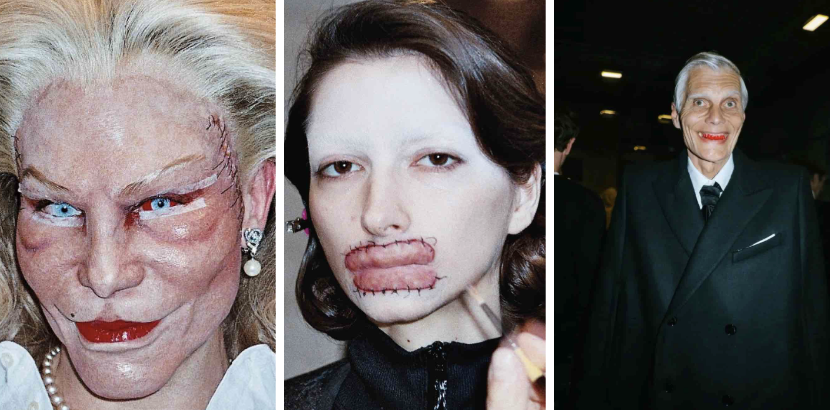
Many of the faces are severely deformed. The elaborate prosthetic work by Alexis Stone is evident in disproportionately large lips with visible stitches, skin stretched backwards, and signs of healing or botched cosmetic surgery. The mouths, fingernails, and, in some cases, even the teeth are stained blood-red, contrasting with the skin, which is mostly rendered in a chalk-white tone. In this context, beauty appears to be forced through extreme bodily modifications and veers into the grotesquerie and monstrosity. The price of beauty is pain.
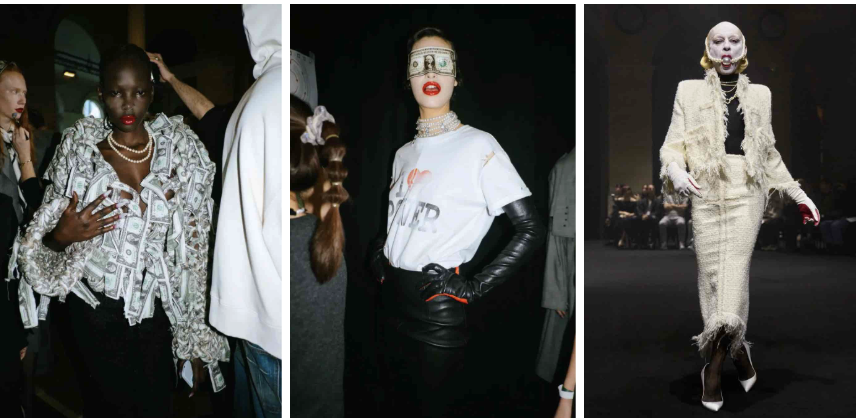
The clothing itself operates within the codes of the elite. Drawing inspiration from a Dior look and 1950s silhouettes, the collection references bespoke suits with pronounced shoulder lines, pleated skirts, and luxurious fabrics such as double-faced cashmere, Prince of Wales check, and déchiré tweed. These traditional class markers are overlaid with contemporary aesthetics of power and status, such as the corporate aesthetics and the office siren. At the same time, these codes are subverted by open seams and torn hems – reminiscent of Lee Alexander McQueen and Rick Owens. Slogans such as “Cult” or “I Love Power”, as well as jackets made from banknotes, explicitly reference power and capital fetishism.
Leather “Guilt Gloves”, whose inner surfaces are dyed blood red, embody the phrase “blood on their hands”. They are paired with heeled shoes designed in collaboration with Christian Louboutin. Whilst the obscenely high-heeled shoes elevate the models above others, they simultaneously cause them to stagger, undermining their status. One-dollar notes become masks that cover the face, thereby staging the anonymity of the rich. The figures are literally blinded by money and thus blind to morality. Pearl necklaces function as restraints or ball gags, so that luxury tips over into a BDSM aesthetic.
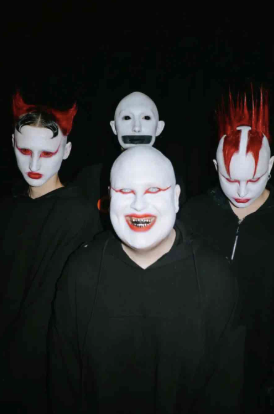
Then the lights dim, the music shifts to more classical, drum-led sounds, and the second part begins. Dark, hooded figures gather in a circle, initially concealed beneath their hoods, which they then remove in unison. This evokes elitist secret societies and cult structures – in some cases, the word ‘Cult’ is even written on their backs – and brings to mind Stanley Kubrick’s Eyes Wide Shut. The Power of Community thus appears as a perverted form of collective, in which belonging arises through exclusivity. The aesthetic is gothic, punk-inspired, and, in true Demna style, reduced to black, with zips and stark silhouettes. White faces, devil-like horns made of red feathers or hair, and black pupils, on the other hand, evoke Satanism.
In the third part, a platform descends from the ceiling, whilst the lighting once again mimics a solar eclipse. The sound of the wind and the darkness frame the transition. Hannah Rose Dalton, one of the designers herself, steps out wearing a cocoon skirt made from an albino-coloured python with frayed hems, nude-toned platform shoes, and an elongated back panel. Further figures follow: shaved heads, sculptural wool and feather constructions, precisely cut trench coats, and leather coats. The music shifts to orchestral string sounds with operatic singing. Alongside billionaire and entrepreneur Bryan Johnson, Michèle Lamy also appears in this section. Here, the Power of the Future is defined through control over bodies and time itself. On the one hand, there is Johnson’s obsession with longevity and immortality. On the other hand, Lamy, who embodies natural ageing. Between these poles, a conflict unfolds between transhumanism and transience. The collection concludes with a silhouette reminiscent of an Elizabethan queen – the ultimate embodiment of ossified power.
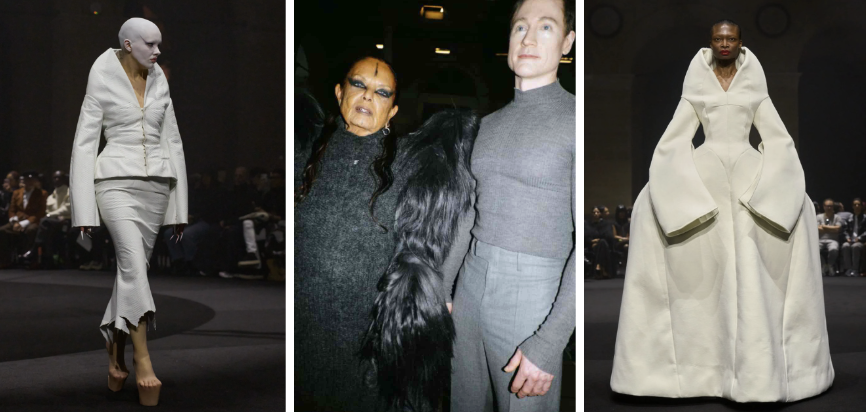
Overall, the collection impresses with its precise tailoring, sharp yet couture-like lines, and a cohesive, subversive narrative that recalls the theatrical storytelling associated with John Galliano. At the same time, the duo is developing their own post-human, alien-like avant-garde aesthetic with a shock factor. Also striking is the diversity of the models, moving beyond standardised thinness and including queer identities. Yet, a lingering sense of unease remains. Isn’t the very class the collection addresses sitting in the audience? How consistent can a critique be if only the one percent can afford the clothes? Is couture really the best medium for this message, or does it remain purely performative?
It is precisely in this tension that the strength of Matières Fécales lies. The project is designed to spit in the face of fashion, not least in its very name, fecal matter. What is considered bullshit becomes the material here, commenting on and criticising the direction of the industry. The duo thus explains that they capture “the beauty and grotesque of the human experience while challenging the glossy façade of a luxury-driven culture,” and in doing so, direct this critique at their own clientele. This makes The One Percent a collection that exposes power whilst simultaneously revealing the inherent contradictions of a fashion’s attempt to critique power from within its own structures.